

1) Redefining Zero-Trust Custody on Bitcoin
The legacy custody problem
In practice, most failures in custodial systems do not come from cryptography “breaking.” They come from:
- centralized key storage,
- privileged operators,
- compromised signing environments,
- or governance processes that can be bypassed under pressure.
Even standard multisig approaches can introduce new weaknesses:
- signer sets may be discoverable and targetable,
- coordination overhead grows with scale,
- operational complexity increases the probability of errors and social-engineering risk.
The FROST model
FROST (Flexible Round-Optimized Schnorr Threshold Signatures) upgrades custody into a zero-trust signing architecture:
- The signing key is split into independent secret shares
- Shares are generated via distributed key generation (no trusted dealer)
- The full private key is never reconstructed
- A threshold of participants collaboratively produce a valid Bitcoin signature
- The final output is a standard Schnorr signature that verifies normally on Bitcoin
Intuition: a Bitcoin vault address controlled by FROST is not protected by “one key” or “one institution,” but by a distributed signing quorum where no single participant is sufficient.
2) How FROST Works: A Step-by-Step Walkthrough
This section explains the signing lifecycle at a conceptual level.
Step 1 — Distributed Key Generation (DKG)
Instead of one entity creating a private key and “splitting it,” FROST participants generate a shared public key together, while each party retains only its secret share.
- one public key (used to control Bitcoin addresses)
- many secret shares (held independently)
- no point in time where the full private key exists
Step 2 — Two-round threshold signing
When a transaction needs authorization, participants produce partial signing contributions using their own share.
FROST is designed to be operationally efficient:
- the signing workflow completes in two rounds
- coordination is minimized compared with legacy threshold approaches
- no participant reveals its secret share during signing
Step 3 — Single signature output (Bitcoin-native)
Partial contributions are aggregated into one final signature.
From the Bitcoin network’s perspective:
- it is a normal Schnorr signature,
- verified under a single public key,
- without exposing the signer set.
This matters because it preserves Bitcoin-native behavior and avoids introducing non-standard “multi-signature artifacts” in the final transaction footprint.
3) Why FROST vs Traditional Alternatives
FROST is often best understood by contrast: it is not only “more secure,” but more scalable and more operationally robust.
|
Capability |
Traditional custody / older threshold methods |
FROST (threshold Schnorr) |
|
Key ownership risk |
A key exists somewhere (or a trusted dealer exists) |
Full key is never reconstructed; no trusted dealer |
|
Coordination overhead |
Higher round complexity, heavy coordination |
Round-optimized signing (efficient coordination) |
|
Signer privacy |
Signer set can be more visible |
Final signature can look like a single-signer output |
|
Fit for modern Bitcoin |
Can feel bolted-on |
Built for the Schnorr/Taproot era |
FROST reduces the likelihood that custody security degrades under real operational stress,because the system is designed to minimize privileged single points of failure.
4) The Concepts That Matter: Zero-Trust, Parallelism, and Indistinguishability
Zero-trust by design
FROST assumes any single signer could be compromised, and it is designed so that this does not become catastrophic.
It assumes one key holder might get hacked so the system is built so one hacked person can’t unlock anything.
- Control over funds is never dependent on one party.
- A valid authorization requires a quorum of independent signers, so even if one signer is breached, an attacker still cannot move assets.
Parallel execution, not sequential bottlenecks
Traditional threshold signing can behave like sequential coordination: each step waits on the previous. FROST is designed to reduce that friction so signing remains reliable and scalable as the signer set grows.
As signer sets grow, traditional threshold signing can become operationally slow because coordination often behaves like a sequence of dependencies.
Instead of people signing one-by-one sequentially, they can do their part at the same time, so it stays fast even with many signers.
- FROST reduces this coordination friction by allowing signing steps to proceed more concurrently
- improving reliability and reducing latency while maintaining the same security threshold.
Privacy and robustness
A signature produced by a FROST quorum verifies like a standard Schnorr signature.
From the outside, it looks like a normal signature, so it doesn’t broadcast this came from a committee vault, which helps privacy and avoids leaking operational details.
- On-chain, this means transactions do not advertise the custody structure or reveal that a committee was involved.
- This reduces metadata leakage while preserving threshold-enforced security internally.
5) How SolvBTC Uses FROST: The Component Model
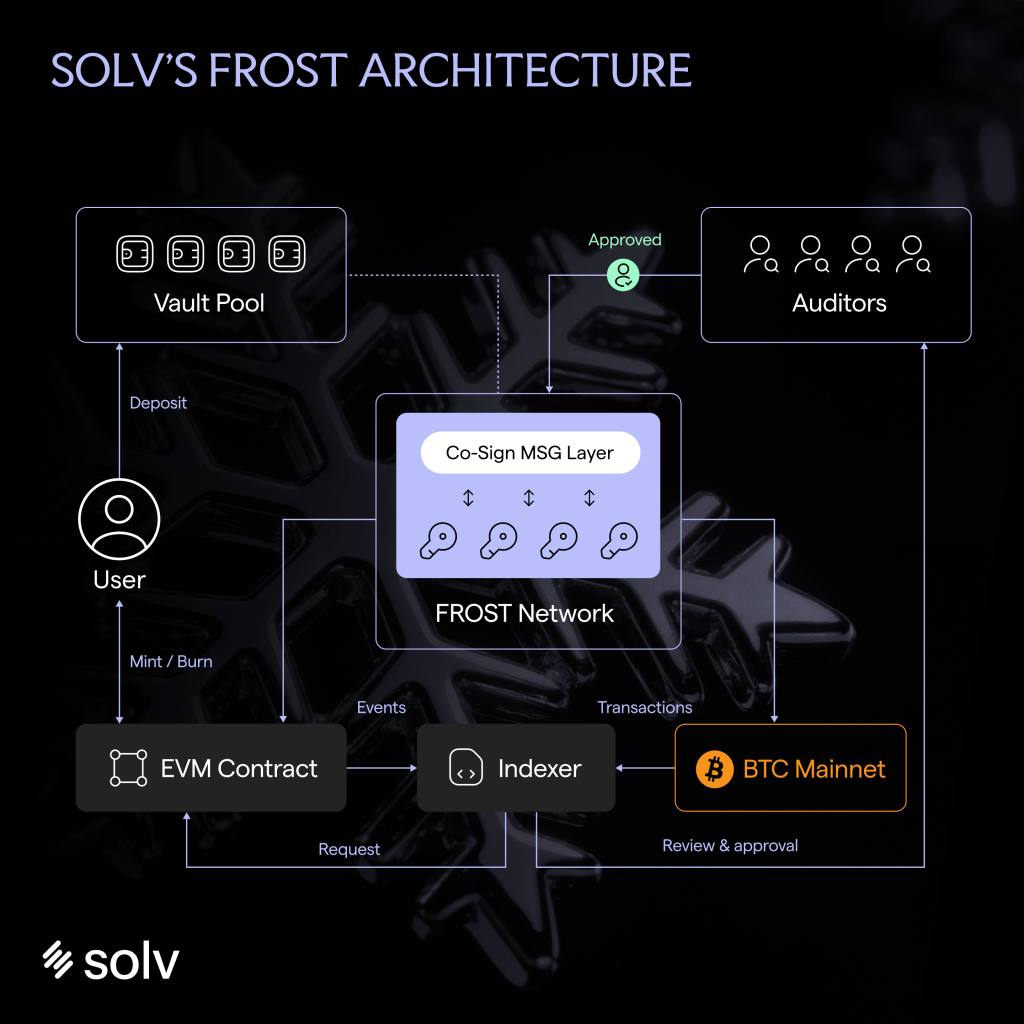
FROST is most powerful when understood as the core inside a broader system.
SolvBTC’s Bitcoin mainnet architecture is built from five components that work together across the asset lifecycle:
a) FROST Network
The distributed signer network is the system’s root of control. It holds secret shares and collectively produces threshold signatures, ensuring that Bitcoin movements require quorum/committee approval and cannot be executed by any single operator.
This is the enforcement point where policy becomes immutable, on-chain settlement on Bitcoin.
b) Vault Pool
A managed set of Bitcoin addresses controlled by the FROST public key, used to receive and store deposited BTC.
The vault pool is a set of Bitcoin addresses controlled by the FROST public key. Deposits can enter freely, but withdrawals are constrained: funds cannot leave the vault pool unless the FROST network signs.
The vault pool defines the custody perimeter; FROST is the cryptographic authorization layer that controls and constrains withdrawals
c) Onchain Smart Contracts (EVM)
EVM contracts define the SolvBTC asset lifecycle, mint, burn, redemption requests, and accounting rules. But these contracts do not custody BTC directly; they express state and intent.
FROST provides the bridge from “contract-approved intent” to “Bitcoin-authorized settlement,” ensuring EVM-side actions remain anchored to Bitcoin-side control.
d) Indexer
The indexer monitors Bitcoin deposits and EVM events and converts them into standardized protocol requests. It is essential for automation and reliability, but it is intentionally non-authoritative: it cannot move BTC and cannot finalize actions on its own.
Its role is to assemble and route requests toward the signing boundary, where FROST enforces the final decision.
e) Auditors
Auditors sit upstream of execution. They review high-risk or policy-bound operations and approve them under defined governance rules. Their approval does not move funds by itself, rather, it acts as a required gate before requests are eligible for FROST signing.
This creates separation of duties: auditors validate permission, FROST enforces execution.
6) Why We Choose Frost: Security That Scales With Adoption
As BTCFi grows, the industry tends to repeat a pattern:
- the cryptography is strong,
- but custody becomes centralized,
- and the human layer becomes the failure layer.
SolvBTC’s FROST-based architecture is designed to break this pattern.
The objective is straightforward:
- preserve Bitcoin mainnet settlement as the anchor,
- minimize single points of failure in custody,
- maintain operational reliability at scale,
- and enforce governed execution paths for minting and redemption.
FROST enables this by turning key control into a distributed system property—rather than an organizational promise.


You must be logged in to post a comment.